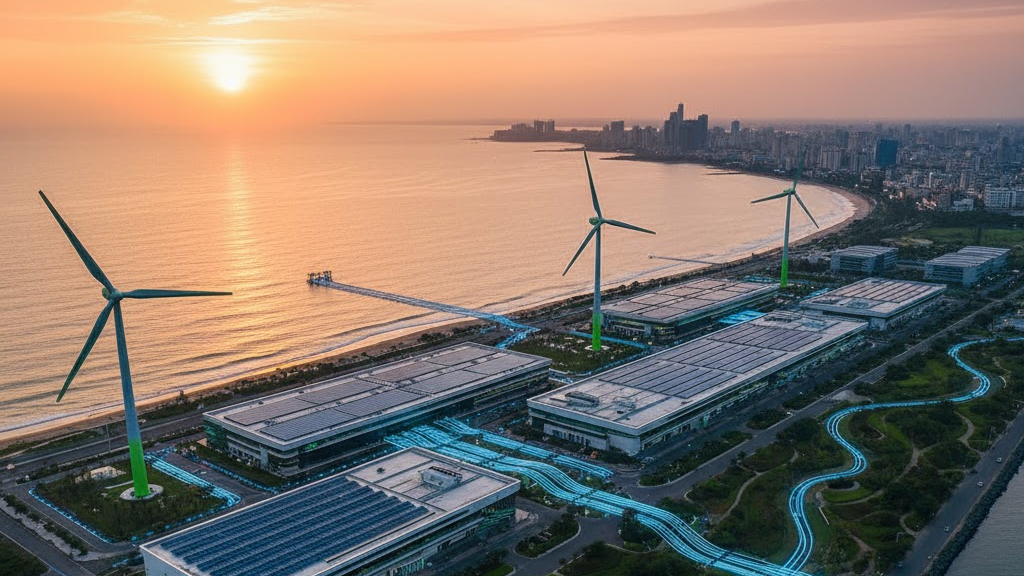
In a move that redefines the global technology map, Google has announced a $15 billion investment to build its first AI hub in Visakhapatnam, India.
Over the next five years, this project will establish cutting-edge data centers, advanced fiber networks, and sustainable power systems, positioning India as a vital link in the expanding web of global AI infrastructure.
This isn’t just an investment — it’s a statement. AI’s future is no longer confined to Silicon Valley; it’s spreading across the world, and India is stepping into the center of that evolution.

Artificial intelligence doesn’t run on code alone, it runs on compute power, fiber networks, and clean energy.
For years, the world’s AI backbone was built around Silicon Valley, Singapore, and Dublin. But Google’s decision to choose Visakhapatnam signals a new era of decentralized infrastructure, spreading technological capacity to emerging global hubs.
The “AI arms race” is no longer just about algorithms, it’s about where those algorithms live, process, and evolve. Visakhapatnam’s inclusion in that race means India is now part of the world’s digital power grid.
India’s digital momentum makes it the perfect choice. With one of the world’s largest developer bases, pro-tech government policies, and massive internet penetration, the country is ready for large-scale AI transformation.
The Digital India and AI Mission programs align seamlessly with Google’s global goals to democratize AI access and foster sustainable innovation.
Visakhapatnam adds strategic value: it’s coastal, energy-rich, and home to a rising wave of tech talent. These factors make it a model location for next-generation data operations.
This isn’t just a corporate expansion, it’s a geopolitical milestone.
In a future where data is power, countries hosting AI infrastructure will influence global innovation, policy, and progress.
The Visakhapatnam hub could become a launchpad for AI research, digital upskilling, and automation in South Asia, linking global companies to India’s rapidly evolving tech ecosystem.
With this $15 billion initiative, Google is essentially building the physical neural network of AI’s future.
From climate modeling to healthcare analytics and generative AI, this infrastructure will drive breakthroughs that shape the next decade.
As AI expands from labs into daily life, Visakhapatnam’s story becomes symbolic of a turning point in how the world builds, powers, and distributes intelligence.
The future of AI isn’t just being imagined in Silicon Valley anymore.
It’s being coded, cooled, and powered on India’s eastern coast.


 Cybervibe
Leave a comment