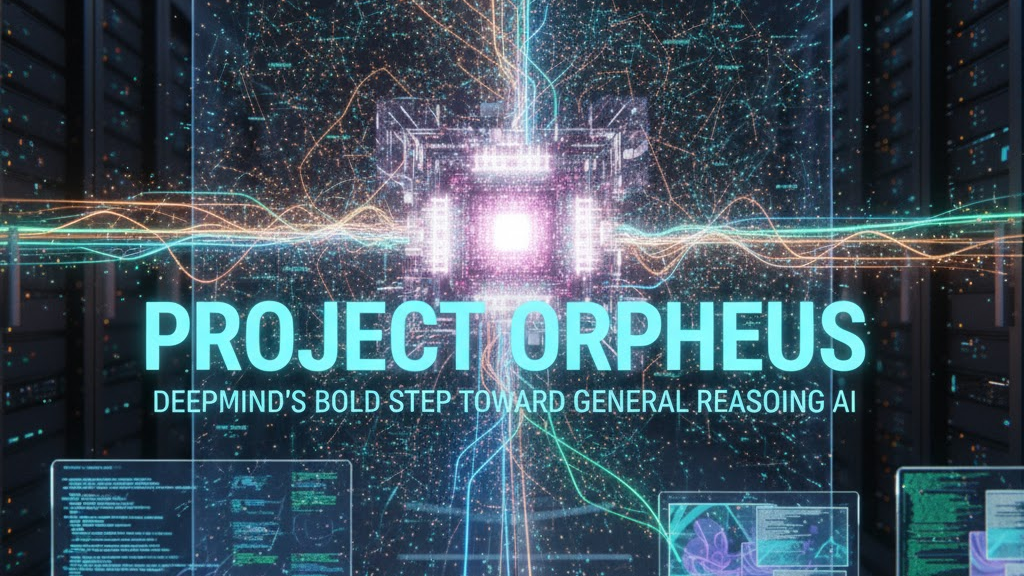
Imagine an AI that can read a research paper, interpret a painting, and then write the code to simulate both within minutes.
That’s not science fiction anymore. That’s Project Orpheus, Google DeepMind’s latest leap toward multimodal general reasoning AI.
For years, AI models have been great at one thing at a time, chatbots that talk, image generators that paint, or coding assistants that debug.
But Orpheus breaks those boundaries. It thinks across text, vision, and code weaving them together in a single reasoning engine.
Most current AIs live in silos.
ChatGPT writes, Midjourney paints, and GitHub Copilot codes. But ask any of them to connect all three creatively and the illusion of “general intelligence” breaks.
DeepMind saw this as the next frontier: a model that doesn’t just generate, but understands and reasons across modalities.
That’s where Project Orpheus steps in.
In simple terms, Orpheus is a multimodal AI system built to handle complex reasoning that spans multiple types of data, text, images, audio, and code.
Think of it as an AI that can:
- Read a problem statement,
- Visualize potential solutions,
- Code the simulation, and
- Explain the results all autonomously.
It’s the closest we’ve come to a true cross-domain creative and reasoning engine.
DeepMind’s engineers describe Orpheus as “a step toward generalized intelligence that can transfer understanding between worlds linguistic, visual, and logical.”
The significance isn’t just technical, it’s philosophical.
For decades, AI research has been chasing one question: Can machines truly reason?
Orpheus doesn’t just process data, it interprets it. It can find conceptual links between a line of poetry and a line of Python, between a painting and a problem set.
This ability to reason by analogy, to transfer insight from one domain to another, is what makes human intelligence unique.
And now, AI is entering that territory.
Early demos showed Orpheus reading biology papers and autonomously writing code to simulate molecular interactions effectively bridging natural language with computational logic.
Designers used Orpheus to generate visuals and interface mockups directly from written briefs. It could interpret vague creative prompts (“Make it feel like dawn breaking over Mars”) into coherent design prototypes.
Imagine a student asking: “Why does E=mc² relate to light speed?”
Orpheus could generate a visual explanation, simulate a small physics experiment in code, and provide a text-based summary of a unified learning experience.
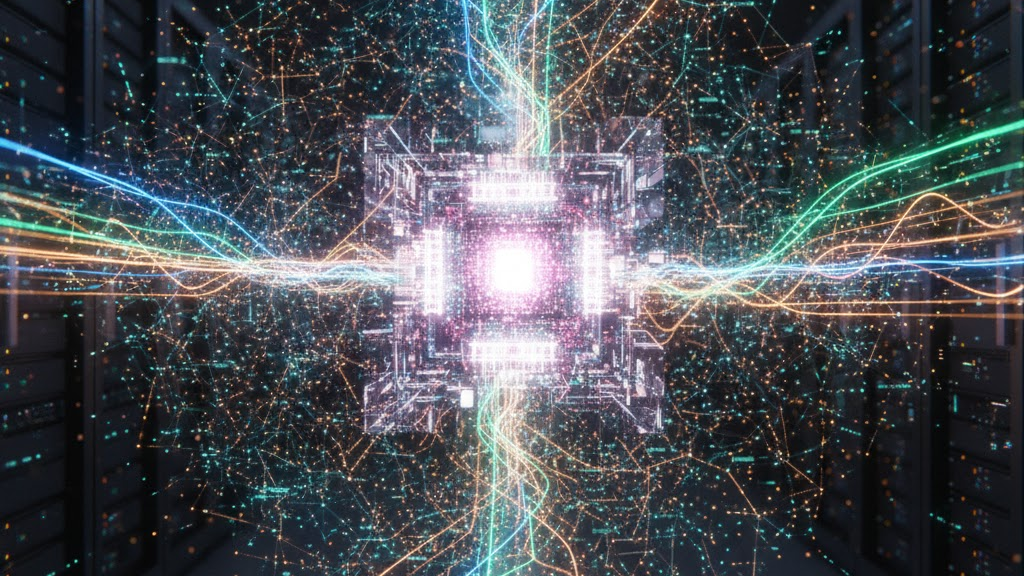
DeepMind hasn’t revealed full technical details, but insiders note that Orpheus uses a hybrid transformer-graph neural network capable of understanding relationships between different data modalities.
The system is trained on massive cross-domain datasets, combining:
- Natural language corpora
- Public code repositories
- Visual datasets
- Symbolic reasoning tasks
This makes Orpheus not just multimodal, but meta-modal, it learns how to learn across domains.
The Impact: From Creativity to Industry
Orpheus could transform:
- Film & Design: Script-to-storyboard generation.
- Science: Natural language to experiment code.
- Business: Data visualization and interpretation in one step.
- Education: Personalized, multimodal tutoring.
In essence, it’s the ultimate assistant for human imagination.
Pros:
True multimodal reasoning
Unlocks creative and scientific collaboration
Reduces fragmentation across AI tools
Cons:
Risk of over-generalization
High compute costs for training and inference
Ethical concerns over deep content synthesis
As DeepMind’s CEO Demis Hassabis said:
“Project Orpheus isn’t about replacing creativity, it’s about amplifying it.”
- AI multimodal systems are expected to account for 40% of all AI applications by 2028 (IDC, 2025).
- Creative industries adopting multimodal AI could see productivity gains of up to 60%.
A European architecture firm used Orpheus to transform text-based design briefs into interactive 3D models saving over 200 hours per project.
What This Means for the Future
Project Orpheus represents the fusion era of AI, where language, art, and logic finally meet.
Just like the mythological Orpheus bridged the worlds of the living and the dead, DeepMind’s version bridges human thought and machine reasoning.
This is not the end of the AI story, it’s the beginning of AI as a collaborator, not competitor.
AI is evolving from understanding language to understanding the world.
Project Orpheus is proof that the next leap in intelligence isn’t just about power, it’s about connection.
If DeepMind succeeds, the future of AI won’t just be smart, it will be truly inspired.


 Cybervibe
Leave a comment