
The Fusion of Two Revolutions :
In a move that could redefine the future of computing, IBM has unveiled its Quantum AI Accelerator Chip, a hardware innovation designed to bridge classical and quantum computing. This chip is not merely a technological milestone, it’s a turning point in how artificial intelligence (AI) systems learn, reason, and evolve.
As AI models grow larger and more complex, traditional silicon architectures struggle to keep pace with their demands for speed, parallelism, and efficiency. IBM’s new chip aims to infuse quantum principles directly into AI processing, bringing exponential capabilities to data-driven industries — from finance and healthcare to cybersecurity and energy.
What Is the Quantum AI Accelerator?
At its core, IBM’s Quantum AI Accelerator Chip is a hybrid processing unit designed to combine quantum mechanics and classical AI algorithms within a unified framework.
Unlike GPUs or TPUs, which rely on deterministic logic, the Quantum AI Accelerator leverages qubit-based computation to explore multiple data states simultaneously. This enables quantum-enhanced machine learning, where models can process probabilistic patterns that were previously beyond classical limits.
IBM has designed this chip to interface seamlessly with its Quantum System Two architecture allowing enterprises to harness quantum capabilities without needing specialized expertise.
Bridging Two Worlds :
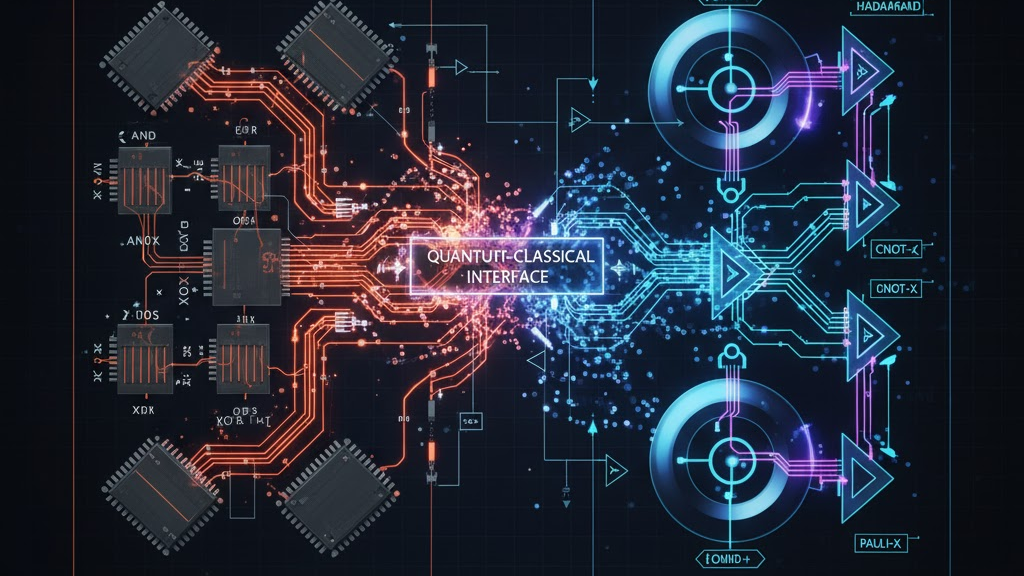
The chip employs a dual-lane computation architecture:
- Classical Lane: Handles traditional AI operations like matrix multiplications, linear regressions, and deep learning layers.
- Quantum Lane: Performs high-dimensional pattern recognition and probabilistic optimization through qubit entanglement and interference.
Together, they enable hybrid workflows, where quantum modules accelerate specific bottlenecks — such as optimization, feature mapping, or uncertainty estimation — while classical circuits manage scalable inference.
IBM calls this synergy Quantum-Classical Co-processing (QCC), a key enabler for next-generation AI models that require both precision and probabilistic reasoning.
Enterprise Use Cases: Real-World Quantum AI
IBM’s new accelerator isn’t a science experiment, it’s built for enterprise applications. Early partnerships are already underway across several domains:
1. Financial Forecasting and Risk Analysis
Quantum-enhanced AI can evaluate complex, nonlinear financial systems more accurately than current Monte Carlo simulations. The chip allows risk models to explore multiple scenarios in parallel, enabling faster and more precise portfolio optimization.
2. Drug Discovery and Genomics
By blending quantum probability modeling with AI-driven molecular design, the chip could dramatically accelerate the search for new medicines. Complex molecular interactions can be simulated in quantum states, something classical supercomputers often approximate.
3. Cybersecurity and Encryption
Quantum AI can identify anomalous network behaviors faster and even anticipate cyber threats before they materialize. IBM’s accelerator enables quantum-safe machine learning, improving both threat detection and cryptographic resilience.
4. Sustainability and Climate Modeling
Quantum-enhanced simulations can optimize energy grids, logistics, and climate patterns allowing governments and corporations to plan sustainable strategies with higher accuracy.
Hardware & Architecture Overview :
IBM’s Quantum AI Accelerator Chip is fabricated using 3-nanometer superconducting materials integrated with cryogenic control systems. It operates at near-absolute-zero temperatures, where qubits maintain coherence and precision.
The chip features:
- 64 high-coherence qubits
- Hybrid tensor cores for AI workloads
- Integrated cryo-controller for low-latency signal translation
- Quantum RAM (QRAM) for temporary state storage
- Photonic interfaces enabling fast classical-quantum communication
This design minimizes the latency traditionally associated with quantum operations and allows AI inference pipelines to utilize quantum resources on-demand, effectively bringing quantum acceleration “on-chip.”
The AI Angle: Smarter, Faster, and More Efficient
With this chip, IBM aims to redefine how AI models are trained and optimized. Traditional AI architectures face power inefficiencies and data bandwidth bottlenecks as models scale into trillions of parameters.
Quantum AI provides a potential escape route by enabling:
- Exponential state-space exploration
- Faster gradient descent convergence
- Improved probabilistic inference
- Reduced training time and energy consumption
IBM researchers claim early benchmarks show up to 40x speed improvements for specific hybrid algorithms and 60% lower power draw compared to GPU-based systems.
Security and Governance Layer :
Recognizing enterprise concerns, IBM embedded a quantum trust framework within the chip’s software stack. This includes:
- Encrypted quantum circuits to prevent data leaks
- Explainable quantum decision layers for compliance
- API-level governance tools integrated with IBM Cloud
The company also announced Quantum AI SDK, a development environment enabling Python and Qiskit integration for machine learning engineers.
Market Implications: The New Arms Race in AI Hardware
IBM’s move places it squarely in the emerging Quantum AI race, alongside Google, NVIDIA, and startups like Rigetti and IonQ.
While others focus on pure quantum computing, IBM’s hybrid approach offers enterprises a realistic on-ramp allowing gradual adoption while leveraging existing AI pipelines.
Analysts predict that by 2030, 30% of enterprise AI models will rely on quantum acceleration. IBM’s strategy ensures it remains at the center of this shift with hardware, software, and cloud infrastructure unified under one ecosystem.
The Road Ahead :
IBM plans to make its Quantum AI Accelerator Chip available via IBM Cloud Quantum Services in early 2026. Developers will be able to experiment with quantum-assisted neural networks, optimization algorithms, and hybrid quantum transformers.
The next decade could see a new class of AI systems, capable of reasoning, patterning, and decision-making at scales once thought impossible.
The Conclusion: Entering the Quantum Intelligence Era
The introduction of IBM’s Quantum AI Accelerator Chip marks a pivotal moment in computing history. By merging the strengths of quantum physics with artificial intelligence, IBM is building the foundation for enterprise-grade quantum cognition, where algorithms not only learn from data but intuit possibilities.
As we move into the age of quantum-accelerated intelligence, one truth becomes clear:
The future of AI isn’t just faster, it’s fundamentally smarter, more adaptive, and more quantum.


 Cybervibe
Leave a comment