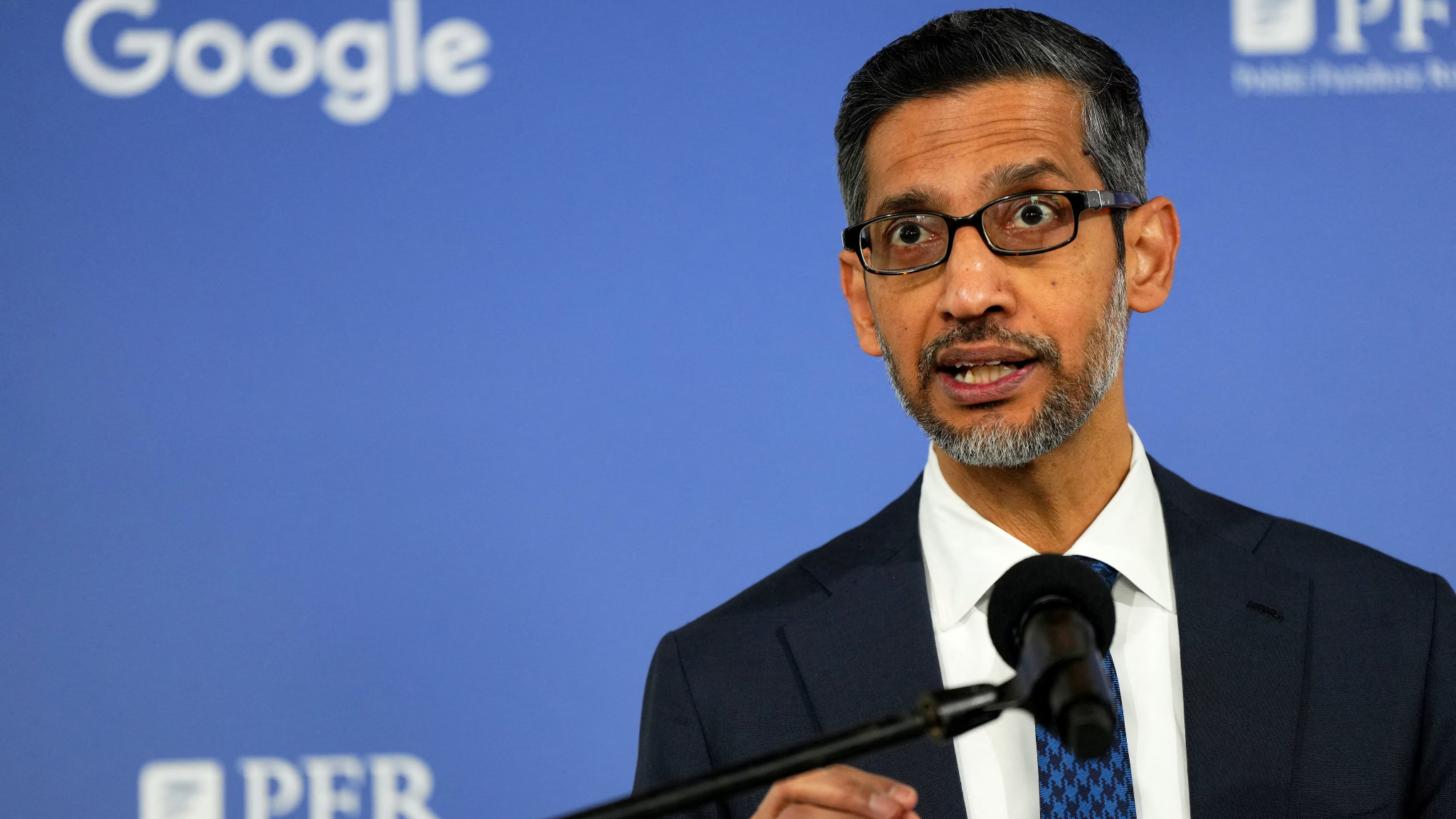
Artificial intelligence has become the hottest investment sector of the decade, bigger than crypto, bigger than Web3, and now challenging even the scale of the early internet boom. But in a surprising and unusually blunt statement, Google CEO Sundar Pichai has issued a warning that is echoing across Silicon Valley, Wall Street, and global AI hubs.
Pichai cautioned that the current AI investment cycle contains “irrational elements”, drawing a direct parallel to the dot-com bubble, one of the most infamous periods of speculative over-investment in tech history. And his message is clear:
If an AI bubble bursts, no company, not even Google is immune.
This is a rare moment when a top tech leader publicly acknowledges overheating. And for startups, investors, and policy makers, the message carries weight far beyond the headline.
Let’s break down what Pichai meant, why he said it, and what it means for the future of AI.
Why Pichai’s Warning Matters Now
Google is one of the world’s largest AI investors, pouring billions into infrastructure, research, silicon design, and global AI deployments. When the CEO of an industry titan warns of irrational behavior, it is not a small statement.
Why now?
Because the AI arms race is expanding at a pace that is historically unsustainable.
Across the world, companies are:
- Spending billions on GPUs
- Purchasing huge cloud commitments
- Acquiring AI startups at extreme valuations
- Building data centers at breakneck speed
- Racing to release new AI models without clear monetization
- Hiring AI talent at inflated salaries
In Pichai’s view, the speed and volume of investment is outpacing fundamentals. That’s a classic signal of a bubble forming.
The AI Hype vs. Reality Gap Is Widening
For every legitimate AI breakthrough, there are hundreds of promises that lack real business value. Many companies are claiming:
- “We’re building AGI.”
- “We’re disrupting entire industries.”
- “We’ll replace all human workflows.”
But the reality today is:
- Most AI tools require expensive infrastructure
- Deployment is harder than expected
- Reliability is still inconsistent
- Monetization is unclear
- Safety and governance lag behind
- Regulatory pressures are rising
These gaps create the conditions for over-investment, especially when valuations jump faster than actual results.
And this is exactly the dynamic Pichai is warning about.
The Cost of AI Is Exploding, But Returns Aren’t Guaranteed
A frontier AI model today costs:
- Hundreds of millions to train
- Billions more in long-term operation
- Massive ongoing GPU and energy spending
- Global inference infrastructure
Companies are scaling spending faster than they’re scaling profits.
Tech giants can survive this.
Startups cannot.
Pichai emphasized this risk: if the bubble bursts, it won’t only hit investors, it will wipe out entire layers of the AI ecosystem.

The Dot-Com Parallel: What We Should Learn
Pichai compared the current situation to the 1999–2000 dot-com bubble, when companies raised billions on hype alone, only to collapse within months.
The similarities include:
- Over-investment with unclear revenue
- Exaggerated promises of disruption
- Pressure to grow faster than infrastructure can support
- Speculation-driven valuations
- Fear of missing out (FOMO) among investors
- Lack of rational cost-benefit analysis
But here’s the difference:
AI is real, powerful, and transformative, the bubble would form around expectations, not the technology itself.
This means after a correction, the strongest players will survive and dominate even more.
What India & Asia Need to Understand
This warning matters even more for India and Asia because these markets are rapidly entering the global AI competition.
Consider the regional context:
- India is launching major AI initiatives
- Asia-Pacific is investing heavily in AI data centers
- Cloud adoption is accelerating
- Startups are chasing AI hype at rapid speed
Pichai’s message for the region is simple:
Don’t build companies only on hype. Build on fundamentals.
Indian and Asian founders must ensure:
- Real market demand
- Sustainable compute spending
- Clear monetization models
- Strong differentiation (not another AI wrapper)
- Long-term infrastructure strategy
Those who follow this path will survive even if a global correction hits.
Why Big Tech Is Nervous
While big companies have deep pockets, they also face massive risks:
- AI infrastructure costs are exploding
- Competition among giants is more intense than ever
- Markets won’t tolerate unlimited spending
- Regulatory scrutiny is rising
- Investors want profits, not promises
The fear is not that AI will fail,
the fear is that the economics of AI may not scale as fast as the hype does.
This mismatch can hurt even the largest corporations.
What This Means for Startups
Pichai’s warning should serve as a strategic roadmap for founders.
Survive the correction, and you’ll own the future.
Startups must:
- Avoid overbuilding before product-market fit
- Use compute efficiently
- Build specialized, not general-purpose, AI
- Focus on revenue from day one
- Avoid unnecessary GPU burn
- Don’t chase hype-driven valuations that set you up to fail
The winners will be those who are disciplined.
The Bottom Line: A Reset Is Coming,Prepare Now
Pichai is not anti-AI.
He is pro-reality.
His message is a reminder that:
- AI is powerful
- But the hype is dangerous
- Over-investment can destabilize the ecosystem
- Companies need sustainable strategies
- The global AI race must be grounded, not speculative
The AI boom will not end,
but it will correct, and only those built on fundamentals will survive and lead.
If you’re an investor, startup founder, engineer, or policymaker, this warning is not fear, it’s foresight.
And foresight is what wins in the next decade of AI.


 Cybervibe
Leave a comment