Artificial intelligence is advancing faster than policy can keep up, and the United States has just entered its most dramatic regulatory showdown yet. A leaked draft executive order from the White House directs the Department of Justice (DOJ) to sue states that implement their own AI regulations, a move that signals the start of a political, technological, and economic tug-of-war with national consequences.
This battle is bigger than Washington vs. the states.
It is about who gets to decide the rules of the future, and how America will balance innovation, safety, fairness, and global competitiveness in an era where AI touches every part of society.
1. How We Got Here: A Nation Without a Unified AI Law
For years, policymakers have warned that the U.S. needs a clear, national approach to AI regulation. But gridlock in Congress has stalled attempts to:
- Create federal AI safety standards
- Define allowable use cases
- Regulate deepfakes, automated decisions, biometric data
- Establish transparency requirements for AI models
- Build a federal framework for accountability
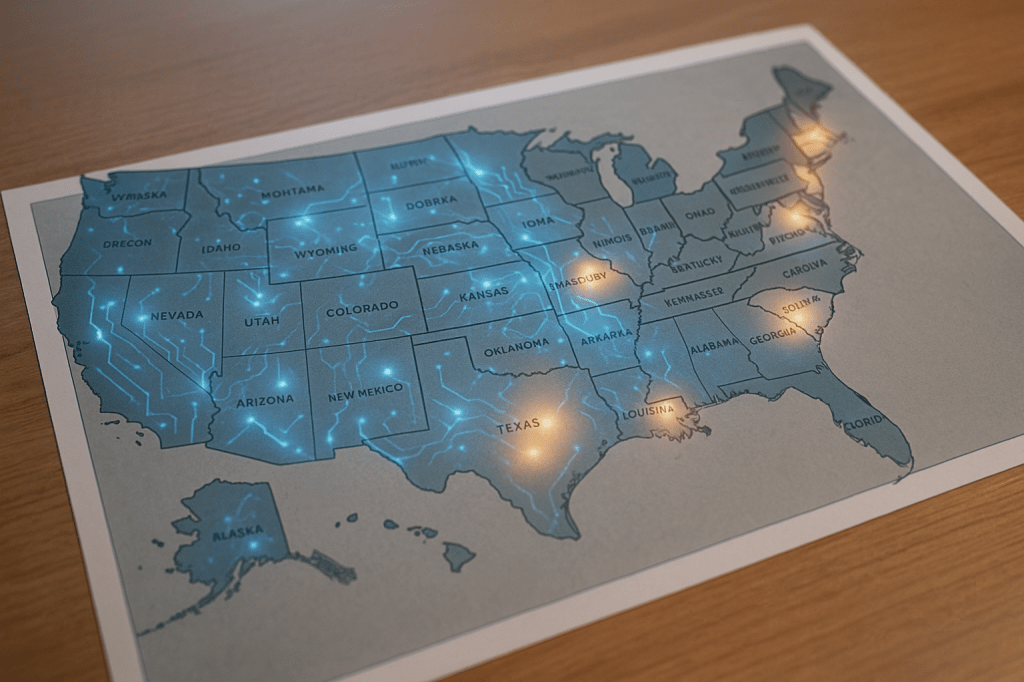
Because Congress failed to pass a federal AI preemption law, individual states began crafting their own rules.
California, Texas, New York, Colorado, and Illinois all took early steps to restrict or guide AI use, particularly in hiring, healthcare, education, policing, and consumer privacy.
This resulted in what tech executives dread the most:
A patchwork of regulations across states.
Companies that operate nationally must comply with differing and sometimes contradictory rules. For industries like:
- Finance
- E-commerce
- Online advertising
- Transport
- Healthcare
- Government services
…this creates legal uncertainty, increased compliance costs, and operational complexity.
So, the White House responded with an aggressive and controversial move:
Stop states from making their own rules by using the DOJ to challenge them.
2. Why This Clash Matters: The Battle for AI’s Future
A. States Want Protection. Washington Wants Control.
States argue they need to protect their citizens from:
- Biased AI decision-making
- Surveillance misuse
- Manipulative deepfakes
- Job displacement impacts
- Unregulated data extraction
States like California and Illinois see tech harm up close, and want the freedom to legislate.
The federal government, meanwhile, believes:
- National innovation will suffer
- American AI competitiveness will weaken
- Companies cannot navigate 50 different AI laws
- Only federal rules can ensure consistency
This philosophical conflict shapes the entire landscape of American AI.
3. The Risks: Innovation vs Regulation Collide
This battle creates three major risks:
1. Economic Uncertainty for Tech Companies
Businesses may face:
- Ambiguous rules
- Conflicting compliance requirements
- Litigation risk across states
- Delays in deploying AI products
- Higher legal and operational costs
Startups and mid-size enterprises are hit the hardest.
2. A Slower Path to AI Safety
Instead of clear, universal guidelines, the U.S. is moving toward lawsuits, politics, and bureaucracy, which delays the creation of safe, ethical AI systems.
3. Global Competitiveness Threat
While the U.S. argues internally:
- The EU already has the AI Act
- China is rapidly expanding state-driven AI governance
- Middle Eastern nations are developing national AI safety strategies
America risks falling behind if regulation turns into political warfare instead of structured policy.
4. What This Means for Companies Right Now
Whether you build AI or simply use it in operations, the landscape has changed.
Expect:
More uncertainty in compliance
Increased legal scrutiny
New federal guidelines overriding state rules
Possible court battles that delay key AI deployments
Greater pressure to document fairness, transparency, and data use
Higher costs for risk assessments and audits
Companies developing or deploying AI should begin preparing federal-grade compliance structures, even if state laws are in dispute.
5. What Happens Next: Three Possible Scenarios
Scenario 1: Federal Government Wins
A national AI framework is enforced, states step back, and companies follow a single unified rulebook.
Scenario 2: States Win in Court
AI regulation becomes fragmented; tech firms must customize compliance state-by-state.
Scenario 3: A Hybrid Model Emerges
Federal baseline rules with state-level add-ons, similar to U.S. environmental laws.
This hybrid model is the most realistic, but the path to get there will be chaotic.
Final Thoughts: We Are Witnessing a Defining Moment
This is not just a legal fight.
It is a historical turning point where the U.S. decides:
Who controls AI? Who protects the public? Who shapes innovation?
And most importantly,
What kind of AI-powered future do we want to build?
The next few months will determine whether America leads the world in ethical, innovative AI…
or loses time, momentum, and trust in a battle between states and Washington.



 Cybervibe
Leave a comment