
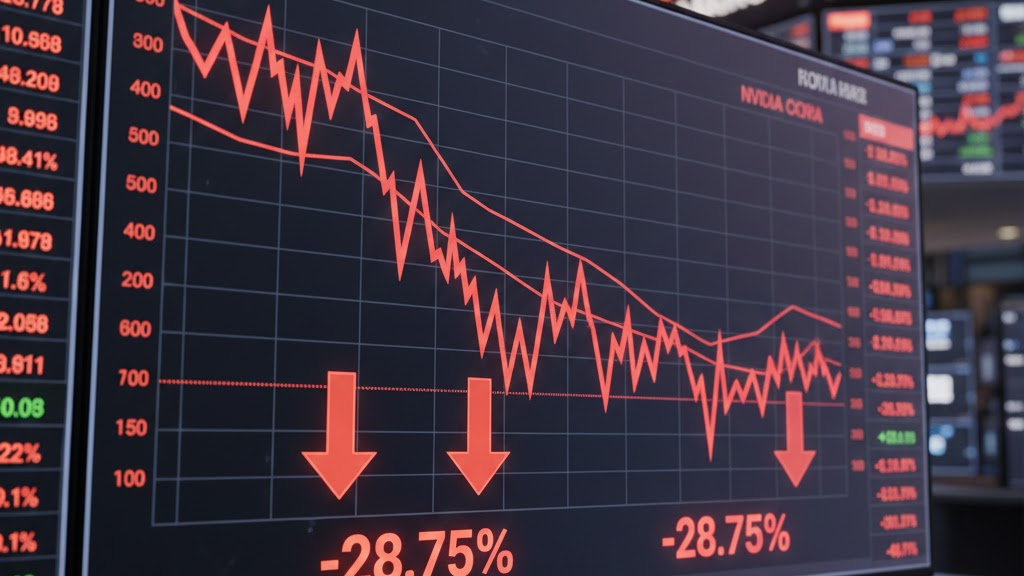
For much of the past two years, artificial intelligence has powered a historic rally in global stock markets. From chipmakers to cloud giants to AI-driven software companies, valuations have soared, excitement has intensified, and investors have poured billions into the sector.
But this week, the momentum hit a wall.
Despite Nvidia posting strong earnings, major U.S. stock indices fell sharply, triggering renewed concerns that the AI boom may be entering overheated territory. Both The Financial Times and The Guardian report that markets reacted with volatility spikes and broad tech sell-offs, even though the world’s leading AI chipmaker exceeded expectations.
This disconnect, strong earnings but negative market reaction, signals something deeper:
Investors are questioning whether AI valuations have moved too far ahead of fundamentals.
Nvidia’s Strong Results Weren’t Enough And That’s a Warning
Normally, when a company as influential as Nvidia beats expectations, markets celebrate.
Instead, the opposite happened.
Why?
Because Nvidia’s success is no longer the primary concern.
The market is now worried about:
- all the other AI companies priced to perfection
- startups that rely heavily on AI hype
- cloud platforms investing billions without guaranteed returns
- data center costs rising faster than revenues
- competition intensifying in chips, cloud, and training models
In short, Nvidia’s strength only spotlighted how aggressively other companies have been riding the AI wave, without proving sustainable business models.
Are We in an AI Bubble? The Warning Signs
The phrase “AI bubble” has been circulating for months, but investors have been divided. Now, with the recent market pullback, concerns are resurfacing.
Here are the biggest red flags analysts are watching:
1. Valuations Are Exceptionally High
Many AI-linked companies, including software vendors, emerging chipmakers, and automation startups, are trading at:
- 50x to 100x earnings
- negative cash flow
- no proven long-term profitability
- rapidly expanding expenses
When companies are valued based on future potential rather than current reality, it creates bubble-like conditions.
2. Revenue Growth Isn’t Matching the Hype
AI adoption is rising, but actual monetization is slower than predicted.
Companies are spending large amounts on:
- GPUs
- model training
- cloud compute
- hiring AI engineers
- energy for data centers
But many are not yet generating revenues that justify these investments.
This imbalance is becoming too big for investors to ignore.
3. Capital Expenditure (CAPEX) Is Exploding
Leading tech giants have announced record levels of spending:
- multi-billion-dollar data center expansion
- long-term GPU orders
- investments in power, cooling, and land
- new AI cloud infrastructure
While these investments support future innovation, they also increase risks, especially if the demand curve doesn’t accelerate as rapidly as projected.
4. Competition Is Increasing Fast
The AI race is not a one-company show anymore.
Competition from:
- AMD
- Intel
- custom chips by Meta, Google, and Amazon
- dozens of AI hardware startups
is putting pressure on margins.
When a sector becomes overcrowded, valuations tend to normalize, often sharply.
Why Tech’s Decline Matters for the Whole Economy
The tech sector isn’t just one slice of the market, it’s the engine of growth for the U.S. economy.
If tech stumbles, the effects spread everywhere.
1. Market Indexes Will Struggle
Tech companies make up a significant share of the S&P 500 and Nasdaq.
Broad declines mean:
- retirement portfolios lose value
- index funds shrink
- investor confidence declines
2. Hiring May Slow Down
Tech companies have been rehiring after 2023–2024 layoffs.
If revenue growth slows, hiring freezes may return.
3. Startup Funding Could Tighten
If investors fear a bubble, venture capital slows dramatically.
AI startups, in particular, are vulnerable.
4. Economic Outlook for 2026 Becomes Uncertain
Tech fuels innovation, productivity, and future growth.
If the sector enters a correction, GDP growth forecasts for 2026 may be revised downward.
But Is This Really a Bubble, or Just a Healthy Correction?
Not every market dip is a bubble bursting.
There’s another perspective gaining traction among analysts:
This is a natural and necessary cooling of an overheated sector.
Reasons why this may be more correction than collapse:
1. AI demand is real and growing
Enterprises are adopting AI tools at scale.
Efficiency gains are measurable.
AI chips remain in short supply.
2. Earnings of leading companies remain strong
The tech giants driving the AI boom, Nvidia, Microsoft, Google, Amazon, are still posting record results.
3. Investors are becoming more selective, not abandoning AI
Money is flowing toward companies with:
- profitability
- robust product-market fit
- strong infrastructure control
- clear competitive advantages
This is a sign of maturation, not collapse.
The Bigger Question: What Happens Next?
Over the next 3–6 months, markets will look for clarity in three areas:
1. Can AI companies turn adoption into real revenue?
Businesses must show:
- paying customers
- recurring contracts
- profitability in AI services
- lower operating costs
Hype is no longer enough.
2. Will capital expenditures start paying off?
If AI models, cloud services, and automation tools scale successfully, spending may be justified.
If not, companies could face write-downs.
3. How will the Federal Reserve influence valuations?
High interest rates hurt tech valuations.
If the Fed delays cuts, volatility could intensify.
Conclusion: The AI Boom Isn’t Over, But It’s Becoming More Honest
The recent market pullback doesn’t signal the end of the AI revolution.
Far from it.
But it does signal a shift:
- from hype to fundamentals
- from speculation to sustainability
- from inflated optimism to selective confidence
Whether this moment becomes a temporary correction or the first chapter of a deeper reset will depend on how quickly the sector proves real economic value.
For now, one thing is certain:
Investors are no longer blindly buying the AI narrative, they’re asking harder questions. And that’s healthy for the market.


 Cybervibe
Leave a comment