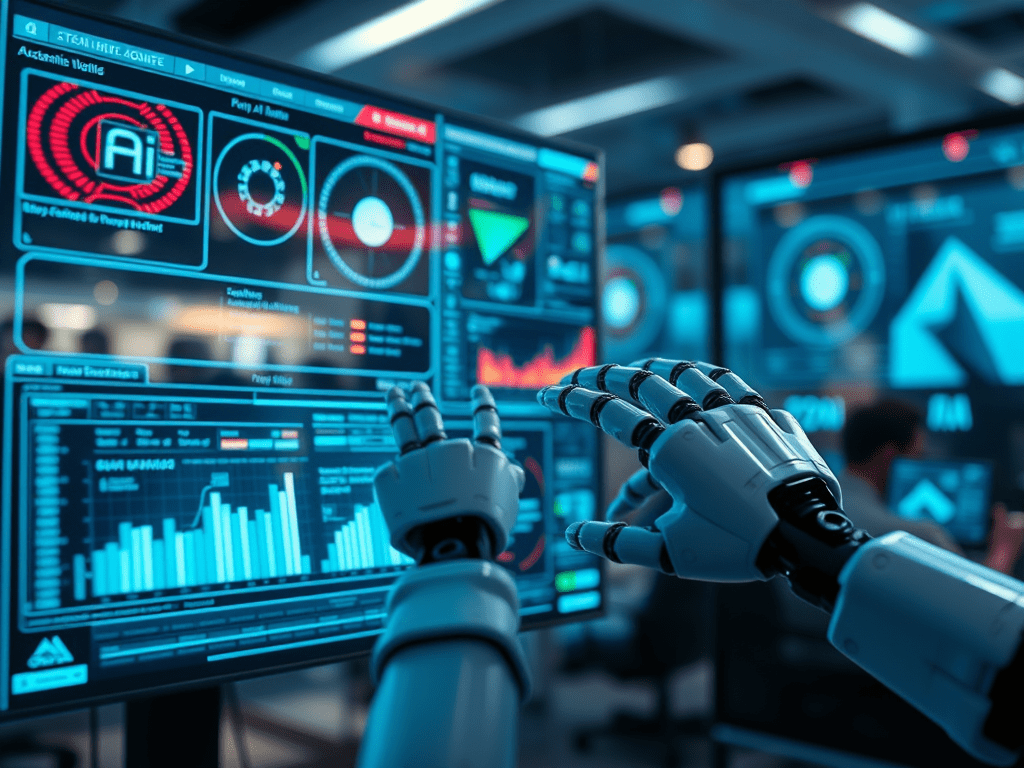
Artificial Intelligence is entering its most transformative phase yet, a shift from assistive AI (tools that respond when asked) to agentic and autonomous AI (systems that plan, act, and execute without constant human direction).
What was once a futuristic idea, machines that handle end-to-end tasks, is now becoming a real part of enterprise workflows, manufacturing operations, customer service, and even strategic decision-making.
According to multiple sources including Gartner, Google Cloud, and McKinsey & Company, autonomous systems are moving from pilot tests to enterprise-level deployment. McKinsey highlights that ~23% of enterprises are already scaling agentic AI systems, signaling a massive shift in how businesses operate.

What Are Agentic & Autonomous AI Systems?
Traditional AI waits for commands.
Agentic AI does something radically different:
Understands goals
Plans multi-step tasks
Executes actions autonomously
Adapts when conditions change
Learns from outcomes
This moves AI from being reactive to becoming proactive.
Think of it as shifting from a calculator to an autonomous employee, one that runs workflows, manages operations, and solves problems at scale.
Why This Matters Right Now
1. Enterprises Are Moving From Testing to Scaling
McKinsey reports that nearly one-quarter of companies are scaling autonomous systems.
This is not an experimental trend anymore, this is becoming core infrastructure.
2. Automation Goes Beyond Analytics
AI is no longer just analyzing data or creating content.
It’s now:
- Running supply chain processes
- Managing cloud infrastructure
- Handling repetitive back-office tasks
- Planning customer-service workflows
- Generating, testing, and updating code
- Monitoring security risks in real-time
Industries like manufacturing, logistics, banking, and healthcare are adopting these systems fastest.
3. Operational Efficiency Skyrockets
Agentic AI can reduce:
Manual workload
Time spent on repetitive tasks
Human error
Operational costs
It increases scalability, productivity, and speed across the entire organization.
Where Autonomous AI Is Being Used Today
Manufacturing
AI agents monitor machines, predict failures, order spare parts, and optimize production without human intervention.
Enterprise Workflows
They manage approvals, schedule tasks, summarize meetings, reply to routine emails, and track projects.
Logistics & Supply Chain
Agents reorder inventory, optimize routes, and forecast demand in real time.
IT & Cloud Management
AI autonomously configures servers, detects vulnerabilities, patches systems, and scales cloud resources.
R&D Automation
Autonomous agents can run experiments, test hypotheses, and iterate faster than human teams.
The Rise of Multi-Agent Systems
One agent is powerful.
But multiple AI agents working together unlocks supercharged automation.
Imagine:
- One agent identifies an opportunity
- Another gathers data
- Another executes the plan
- Another monitors the outcome
This is the future of digital workflows, fully automated, multi-layered task ecosystems.

The Governance Question: Who Controls Autonomous AI?
As AI becomes more autonomous, new challenges emerge:
Safety
How do we ensure agents act within boundaries?
Ethics
Who is responsible for an autonomous decision?
Control
How do we maintain authority over systems that plan and act?
Transparency
Businesses will need monitoring dashboards, override mechanisms, and clear policy frameworks.
Governance will be the deciding factor in whether agentic AI becomes a benefit or a risk.
What to Watch Next
Enterprise-level AI agents in daily workflows
Self-improving agents that rewrite their own strategies
Multi-agent networks working like “digital teams”
New regulations around AI autonomy and machine decision-making
Major job role transformations as autonomous systems scale
Autonomous AI is poised to redefine how we work, operate, and innovate, much faster than many predicted.
Conclusion: The Era of Actionable AI Has Arrived
Agentic & autonomous AI systems are not science fiction anymore, they are becoming the backbone of modern enterprises.
Businesses that adapt early will gain a massive competitive advantage through speed, efficiency, and scalable automation. Those who delay may fall behind as automation becomes the new normal.
This is the beginning of a technological shift where AI doesn’t just support work…
it performs the work.


 Cybervibe
Leave a comment