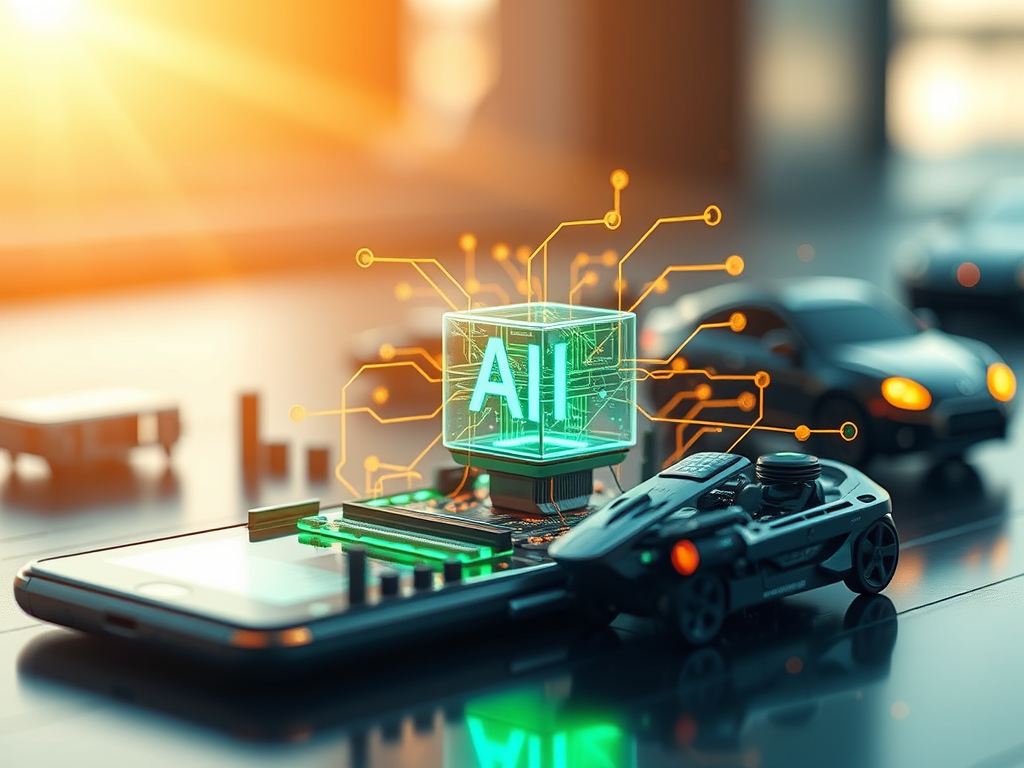

For years, the AI race has been dominated by massive cloud-scale models, trillion-parameter systems powered by global data centers. But a new wave of innovation is quietly reshaping the future of AI.
According to ETCJournal, the industry is now moving toward small, efficient, privacy-friendly, and emotionally aware AI. And the implications are huge.
This shift marks a maturing stage of the AI revolution:
Not bigger, but smarter. Not centralized, but distributed. Not just powerful, but more human.
1. The Rise of Small & Edge AI, Intelligence Without the Cloud
The biggest trend is the rise of Small AI or Edge AI:
compact models running directly on devices like:
- smartphones
- wearables
- cars
- home appliances
- industrial machinery
Think of AI that works even without internet access.
Why this matters
Better privacy, Data stays on your device, not on a server.
Lower latency, Instant responses with no network delay.
Greater accessibility, Works everywhere, even in low-connectivity regions.
Energy-efficient, Uses less compute, battery, and bandwidth.
As hardware becomes more powerful, thanks to neural accelerators, NPUs and optimized chipsets, edge AI is becoming not just possible, but powerful.
We’re entering an era where your phone, watch, and even your car could run their own mini-LLMs.
2. Context Engineering, The New Secret Weapon of Smart AI
Another major shift is context engineering, the art of giving AI models richer and more meaningful context for decision-making.
Instead of brute-force scaling, developers are focusing on:
- structured memory
- personalized context windows
- longer-term understanding of user behavior
- smarter prompt design
- “situational awareness” in AI agents
This makes AI feel intelligent rather than merely predictive.
Example:
An AI assistant that remembers your habits and adapts without being explicitly told, from writing style to tasks to preferences.
This moves AI closer to true personalized intelligence.
3. AI Forgetting Mechanisms, Smarter & More Ethical Memory
AI models that forget may sound strange, but it’s one of the most important innovations of the decade.
Developers are now researching mechanisms that allow AI systems to:
- selectively erase data
- forget outdated information
- comply with privacy rules
- improve safety by avoiding overfitting
- reduce hallucination by cleaning stale memory
Why forgetting matters
Protects user privacy
Prevents long-term misuse
Keeps AI knowledge fresh
Helps models reason more accurately
Just like the human brain, AI needs both memory and healthy forgetting.

4. Emotionally Aware AI Agents, Human-Like Understanding
We’re now seeing the evolution of agents that can understand emotional tone, intention, and interpersonal context.
Emotionally aware AI can:
- detect user mood
- adjust tone dynamically
- respond with empathy
- tailor advice to emotional state
- improve communication and clarity
This doesn’t mean AI becoming human, but it does mean AI becoming a better listener, communicator, and helper.
Applications include:
- mental wellness companions
- teachers and learning coaches
- customer service agents
- creative co-writers
- negotiation and mediation tools
This is the next step in human-AI interaction.
The Bigger Picture: AI Is Becoming More Human-Centric
These emerging trends, small AI models, edge processing, context engineering, intentional forgetting, emotional intelligence, point to one shared mission:
AI that works for people, not just for companies.
Instead of only building giant cloud models costing billions, the industry is shifting to:
- safer
- more portable
- more private
- more personal
- more energy-efficient
forms of AI.
This evolution will make AI:
accessible globally
more trustworthy
more sustainable
more integrated into everyday life
It’s a step toward the democratization of intelligence.
Conclusion
The future of AI is not just about scale, it’s about smart design.
The rise of edge AI, better context systems, forgetting mechanisms, and emotionally aware agents shows a clear direction:
AI is becoming more adaptive, ethical, efficient, and human-centered.
We’re moving from the age of “monster models in the cloud” to an era of everyday intelligence everywhere, in your pocket, on your wrist, in your home, and in your workflow.
The next wave of AI won’t just be powerful.
It will be personal.


 Cybervibe
Leave a comment