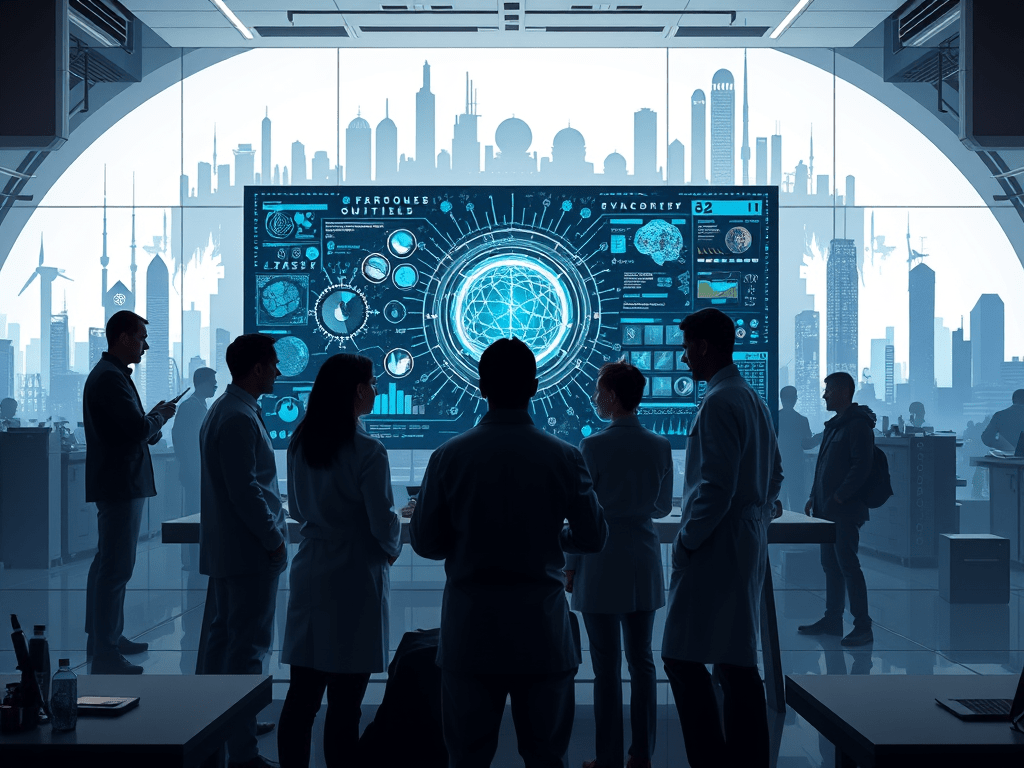

In a landmark moment for global technology leadership, the United States has officially launched the Genesis Mission, a massive new initiative designed to use Artificial Intelligence to accelerate scientific discovery across some of the most important fields of the 21st century.
Announced through AP News, the mission is already being compared to historic national projects like the Apollo program, signalling how deeply governments now believe in the power of AI to reshape the future of science, security, and global competitiveness.
The Genesis Mission represents not just another investment, but a structural shift in how nations approach science, research, and innovation. It aims to bring together the U.S. government’s strongest pillars of innovation:
- National laboratories
- Top-tier universities
- Private-sector technology companies
- AI researchers and high-performance computing teams
The goal?
To unlock breakthroughs that would traditionally take decades, compressing them into years, or even months, using advanced AI systems.
A New Era of Science Powered by AI
The Genesis Mission is built around one powerful idea:
AI can analyze scientific data far faster, far deeper, and at far larger scales than humans ever could.
This shift matters because many scientific fields, from climate modelling to energy research to advanced material science, rely on:
- massive datasets
- complex simulations
- multi-dimensional modeling
- high-performance computing
- predictive algorithms
Until recently, even supercomputers struggled with the scale and complexity of these tasks. But generative AI, multimodal systems, and scientific reasoning models have changed the equation entirely.
The U.S. is betting big on the idea that AI-driven science will unlock discoveries that traditional computing cannot reach alone.
What the Genesis Mission Will Focus On
According to AP News, the program will prioritize several high-impact sectors:
1. Clean Energy & Climate Technologies
AI-driven energy research could lead to breakthroughs in:
- fusion energy
- next-generation solar materials
- high-efficiency storage solutions
- climate-resilient infrastructure
Energy is one of the biggest bottlenecks for both economic growth and national security. With AI, simulations that once required months can now be completed in hours, drastically accelerating innovation.
2. Engineering & Advanced Materials
AI can now:
- design new materials atom-by-atom
- simulate durability under extreme conditions
- identify new alloys or compounds for manufacturing
- optimize mechanical structures with near-perfect precision
This will be game-changing for aerospace, construction, space exploration, and defense technology.
3. National Security & Strategic Technologies
Governments worldwide recognize that AI is now a national security asset, just like defense infrastructure or intelligence systems.
The Genesis Mission will help accelerate:
- cyber defense
- satellite imaging analysis
- threat detection and prediction
- secure AI tools for federal agencies
- defense engineering simulations
Analysts say this step reflects how “AI supremacy” is becoming the next major strategic race, similar to the space race of the 20th century.
4. High-Performance Computing + AI Integration
The mission pairs AI with America’s ultra-powerful national science supercomputers, unlocking:
- ultra-fast simulations
- climate models at unprecedented accuracy
- molecular discovery
- advanced cryptography
- quantum computing research
This fusion, HPC + AI, is widely believed to be the next frontier of scientific speed.

Why Analysts Compare It to the Apollo Program
Some experts say the Genesis Mission has similarities to the Apollo program, which took Americans to the moon.
Here’s why the comparison makes sense:
Scale of ambition
Just as Apollo stretched the limits of aerospace, Genesis aims to stretch the limits of scientific computation and AI reasoning.
Multi-sector collaboration
Apollo united government, academia, and private aerospace engineers.
Genesis unites government, AI labs, cloud companies, and universities.
Economic and global impact
Apollo transformed:
- aviation
- materials science
- computing
- global scientific prestige
Genesis aims to transform:
- clean energy
- medicine
- national security
- advanced computing
- economic growth
A defining technological moment
Apollo marked the peak of the space race.
Genesis could mark the beginning of AI-driven scientific civilization.
What This Means for the World
The Genesis Mission isn’t just an American project, it will have global ripple effects.
1. A New Global AI–Science Arms Race
Other nations — including China, EU countries, India, Japan, and South Korea — are already launching national AI initiatives.
Genesis will likely intensify this competitive push.
Expect:
- more government AI investments
- more international collaborations
- more geopolitical AI alliances
- faster tech breakthroughs globally
2. Faster Scientific Breakthroughs
AI may help unlock discoveries humanity has sought for decades:
- clean, unlimited fusion energy
- new medical cures
- advanced climate models
- quantum-safe cryptography
- lighter, stronger materials
- next-generation batteries
Genesis accelerates all of this.
3. More Opportunities for Researchers & Startups
The initiative expands opportunities across:
- AI development
- scientific computing
- engineering
- hardware
- cloud and HPC
- scientific modeling
Universities and startups will play a much bigger role in national innovation ecosystems.
4. Strengthening National Security
AI-enabled prediction, modeling, and threat detection will become standard tools for defense and intelligence communities. Genesis ensures the U.S. stays ahead in this domain.
Conclusion: A Defining Moment for AI and Humanity
The Genesis Mission is more than a research program, it is a declaration that AI is now central to the future of scientific discovery, national competitiveness, and global progress.
Just as the Apollo program redefined space exploration, Genesis may redefine how humanity discovers new knowledge.
Artificial Intelligence is no longer just helping us work smarter,
it may help us discover faster, explore deeper, and create the next era of scientific breakthroughs.


 Cybervibe
Leave a comment