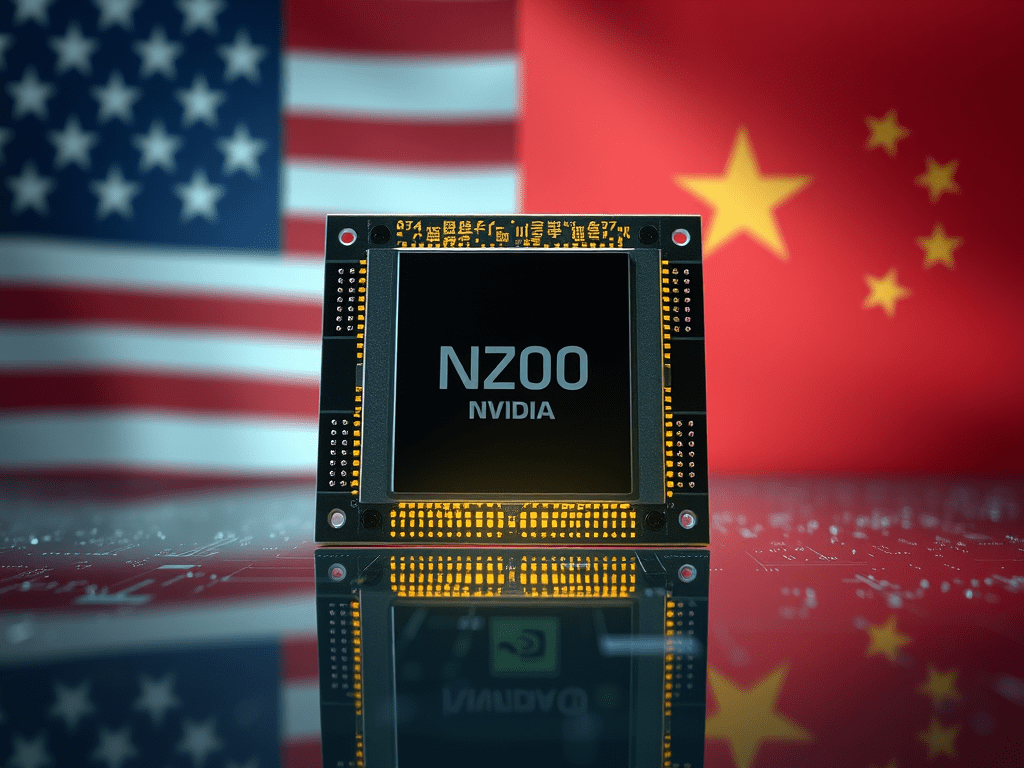
On December 8, 2025, Donald J. Trump announced that the U.S. will permit Nvidia to export its H200 AI chips to “approved customers” in China, a dramatic pivot in U.S. export-control policy.
This isn’t a free-for-all: shipments are subject to vetting by the U.S. Department of Commerce, and the U.S. will collect a 25% fee on such sales.
Importantly, the export permission does not extend to Nvidia’s most advanced chips the Blackwell series, and the upcoming Rubin chips remain off-limits.
Why This Is a Big Shift
From Restriction to Conditional Export
Since 2022, under the export-control regime targeting advanced computing chips, the U.S. has heavily regulated exports to China, citing national-security concerns and fear that powerful AI chips could aid military or surveillance capabilities.
By allowing H200 exports (albeit under strict controls), the administration appears to be rethinking the balance between commercial interests, global AI leadership, and national security. It’s a compromise: allow access, but not to the bleeding-edge hardware.
A Potential Reopening of A Lost Market
For Nvidia and other U.S. AI-chip makers, China represents a massive market — with high demand for data-centre class hardware. By reopening exports (even if limited to “older” but still powerful chips), U.S. firms may regain market share lost during export bans.
In industry circles, this move is being described as a “strategic win-win” helping maintain U.S. technological dominance while letting companies compete globally.
Potential Impacts Positive and Negative
What Could Go Right
- Revenue & Market Expansion for U.S. Chip Firms: Opening China (and possibly other countries) to H200 sales could significantly boost sales and profits for Nvidia — and by extension, support U.S. jobs and innovation in semiconductor manufacturing.
- Global Standardization on U.S.-Built AI Hardware & Software: Maintaining influence over China’s AI infrastructure helps uphold U.S. standards (like CUDA ecosystem) globally, preserving long-term tech leverage.
- A Middle-Ground to Export Controls: By limiting export to “mature but capable” chips (H200) while restricting cutting-edge gear (Blackwell/Rubin), the U.S. navigates a compromise between security and commerce, potentially a model for how to handle AI-chip export policy.
What Could Go Wrong
- Security and Strategic Risks: Critics warn China could leverage H200 chips to accelerate its AI capabilities including for surveillance or military use. Some U.S. lawmakers have called the move a “colossal national-security failure.”
- Dependence on U.S. Hardware: Allowing sales may actually slow China’s drive towards domestic AI chip self-reliance, but that could also mean the U.S. retains leverage in global AI supply-chains, for now.
- Uncertainty Over Chinese Acceptance: Even if allowed, there’s no guarantee Chinese firms will adopt H200 at scale. Some analysts point out China might stick to domestically developed chips or those already certified under prior export rules.
What This Means for the Global AI Landscape
This decision could reshape how AI compute power is distributed globally. For years, the U.S. tried to slow China’s AI progress by restricting exports. Now, with measured reopening, we might see renewed cross-border AI development, with Chinese firms using U.S.-designed chips at least in the medium term.
That said, the “balance sheet” remains uncertain. While companies stand to gain commercially, national-security risks and geopolitical complexity (especially tensions between U.S. and China) will cast a long shadow.
Moreover as some analysts note this sets a precedent: U.S. policy may tilt more towards regulated exports + oversight, rather than outright bans. That could influence export controls globally, especially in how AI hardware trade is framed in the coming years.
- Which companies will get “approved customer” status? The devil is in the details. Who qualifies will shape whether the export relaxation leads to a big China AI-chip boom or just a handful of limited sales.
- How China responds whether it adopts H200 or pushes harder on its domestic chips. If Beijing leans into homegrown chip-makers, U.S. influence could fade, regardless of export policy.
- Whether U.S. Congress pushes back. There are bipartisan concerns over national security; attempts to pass legislation restricting chip exports to China again may arise.
- Long-term impacts on the global AI supply chain. This may accelerate interconnectedness or prompt a bifurcation (U.S.-aligned vs. China-aligned AI ecosystems).
The decision to green-light exports of H200 AI chips marks a pivotal inflection point in the global AI race. It underscores how economic and strategic interests are intertwined in the semiconductor world and how policy can shift rapidly under changing global dynamics.
Whether this move will pay off for industry, for national security, or for global AI development, remains to be seen. What’s clear: the global AI hardware landscape just grew more complex.


 Cybervibe
Leave a comment